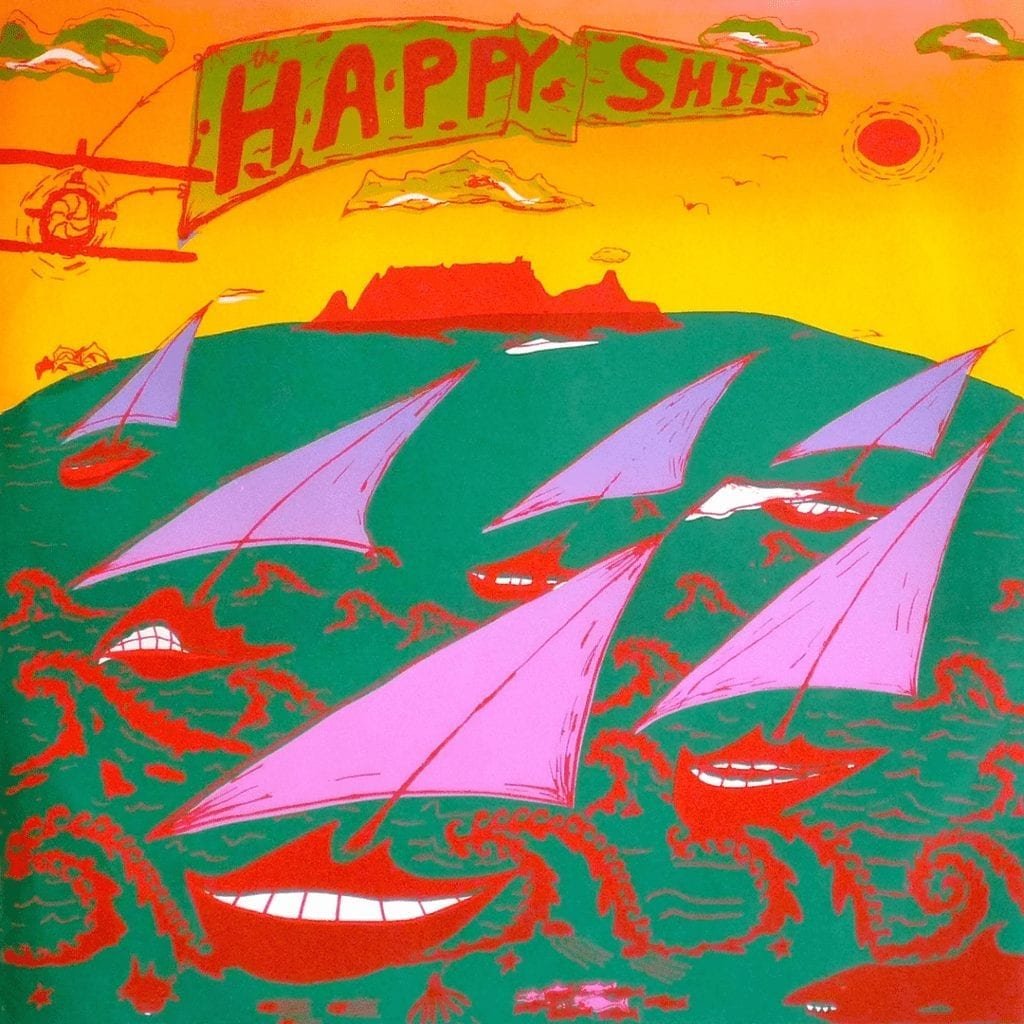
Happy Ships
This was the last band that I was a fully-fledged member of before I gave up the glamour, bright lights, groupies and wheelbarrow loads full of money that defined the life of a gigging alternative musician in sleepy Cape Town in the early 80’s.
What helped the Ships’ rake in even more cash was the fact that we were experimental and played only once a year. As an early indication of how eclectic the Shifty catalogue was going to turn out, this album came out hot on the heels of Shifty’s first release, Sankomota.
Listening to “Sound Future” after all these years makes me feel… kinda…proud. It still sounds fresh, full of fab ideas and whacky youthful vigor. – Lloyd Ross
Jono Partridge – the pocket
Wayne Rath – drums, guitar, vocals
Phillip Nangle – agricultural implements, vocals, chants
Lloyd Ross – guitar, bass, voice, studio
Hamish Davidson – sax, voice, implements
Warrick Sony – bass, drums, voice, trombone
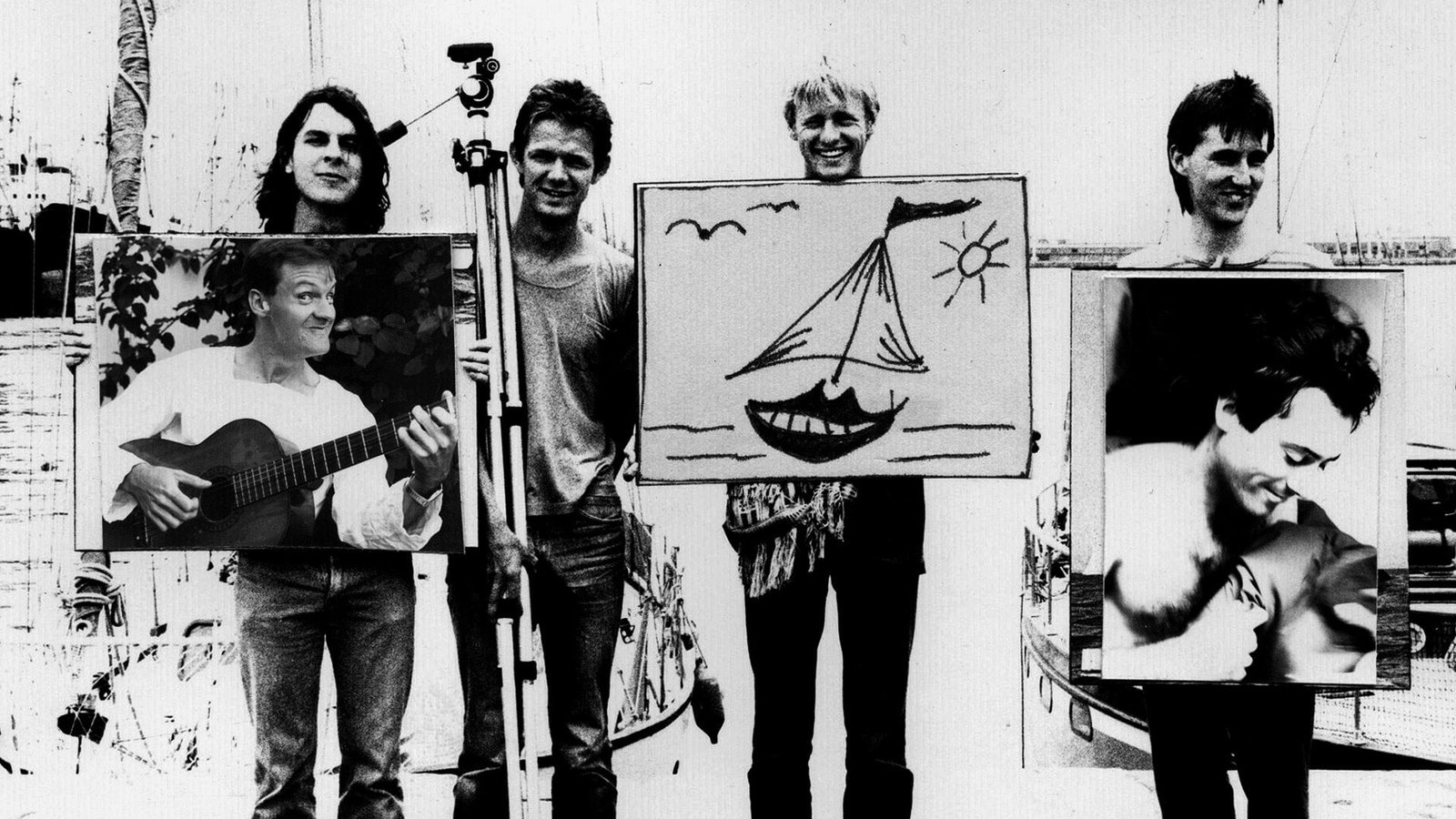
The Happy Ships as remembered by Hamish Davidson
Cape Town in 1980 was a wonderful place. Warrick Sony and I had just got out of two years of compulsory national service and it felt like getting out of prison. We were ready to party and the New Wave was sweeping the Peninsula. I got into “The Lancaster Band” playing sax in a trilby and shades and Warrick joined “The Rude Dementals” a punk outfit. Lloyd had a band called “Rubbish” in which Wayne Raath played bass or drums or both.
In terms of venues, there was “1886” and later that year, “Scratch” opened. Scratch was maybe the first reggae club in Africa. If it wasn’t the first then it was surely the best! Jerry Dixon had an incredible sound rig set up and Henry Coombs imported and spun the latest and hottest disks.
By the end of 1980 we had all left our respective bands and were working in small units pursuing experimental stuff. The units were basically Warrick and me on the one hand and Wayne and Phillip Nangle on the other. If it had not been for Lloyd Ross, the “Happy Ships” would not have happened. He seemed to have the energy, positivity, and desire to get us together.
I remember a meeting at Phillip’s house where we all just sat around talking music and seeing if we liked each other. At one point in the evening, Lloyd asked Wayne and Phillip to do their ‘guitar thing’. Warrick and I weren’t expecting to be impressed I can assure you, but what they did was incredible. It consisted of two out of sync and somehow interlocking guitar parts that were positively ‘unhinged’. It was pure Captain Beefheart! After that we both thought, “OK we can work with these guys”. That guitar thing became Egg and Bacon Plantation.
I’ll talk a bit about Egg And Bacon Plantation to give you some idea of how we worked. Warrick found a slow 3 underneath that guitar thing on drums, in effect turning the piece into a waltz and I put a ‘hokey’ horn melody on top. In the army where Warrick and I had both been in a military band, I had learned to get this fractured sound out of the saxophone by singing and blowing through the horn at the same time. Lloyd dug it and from then on I was a happy ship only to the extent that I shredded my reeds. The melody goes into a Star-Spangled Banner quote that helps to give the tune its ‘Yankee Doodle’ vibe. We added roosters crowing to complement the manic singing. The whole thing is a bit like a red neck barn dance in the deep South where the moonshine has been spiked with acid!
Towards the end of the piece, the guitar part starts modulating upwards in half steps. On saxophone this was not as easy to do. Being a relatively limited player at that time, you can hear that I lose it after a while. But not to worry, the whole band loses it shortly afterward and the piece ends in a glorious cacophony. This was a standard Happy Ships type ending. Things fell apart. The center would not hold.
We did only three live performances at the end of the years 1980, 1981 and 1983. We skipped 1982 because that was the year that Lloyd moved to Johannesburg to set up Shifty Records. The first two were resoundingly successful, the last one, more of a reunion after we had finished recording the album.
The reason for the success of the first two performances had a lot to do with the venue. Scratch Club had an incredible sound system and a large following. To play through that sound rig was a sheer pleasure. Christ only knows why they took a chance on an experimental band like us because, to my knowledge, no one had played that gig before. They seemed to like us. Jerry Dixon had a history of experimental music himself.
Another reason for the successes was the mix of technology and anti-technology. We had several lovely old analog synths at our disposal, plus effects pedals and drum machines. Then on top of all of this there was a battery of pots and pans and a plethora of kiddies toys. “Not so much Dada as Gaga” I recall one critic saying, which leads on to the final reason for our success……. in a word, ‘expectation’. With at least a year between performances, we were well marketed and anticipated so that people came there expecting a wild and unpredictable time.
They got it!
Sound Future
Happy Ships (1984)